

Dental Implants in Bogotá: What Nobody Tells You Before Replacing a Tooth What if the most important thing before getting a dental implant wasn't how much it costs, but everything nobody has explained to you yet?
Sometimes losing a tooth doesn't seem like a big deal at first. What many people don't realize is that, over time, neighboring teeth can shift into the empty space, alter your bite, and even put you at risk of losing more teeth if complications aren't addressed in time. But the consequences are also felt in everyday moments: smiling for a photo, eating something you used to enjoy, or talking while constantly thinking about that gap. And when you start looking for solutions, doubts start creeping in: Will it hurt? How long will it take? Is it worth it? What if the implant doesn't work?
If you're searching for dental implants in Bogotá,there's something you should know from the start: replacing a tooth isn't just about putting a new piece in place. It’s a multi-step process that involves decisions and careful planning. At Natural Smile & Dental Care, located in northern Bogotá, we believe that fully understanding the process before you start is the best way to make a decision with peace of mind. Here is what almost nobody tells you.
An implant is not just a tooth: it’s made up of three parts
A dental implant is a small screw, usually made of titanium, that is placed inside the jawbone. Its job is to replace the root of the missing tooth so that a new tooth can be placed on top of it.
That’s why, even though many people picture an implant as a complete single tooth, the treatment actually involves three distinct components:
- The implant: The base that goes inside the bone and provides support.
- The abutment: The connector piece that joins the implant to the new tooth.
- The crown: The visible part that looks like a natural tooth and allows you to chew
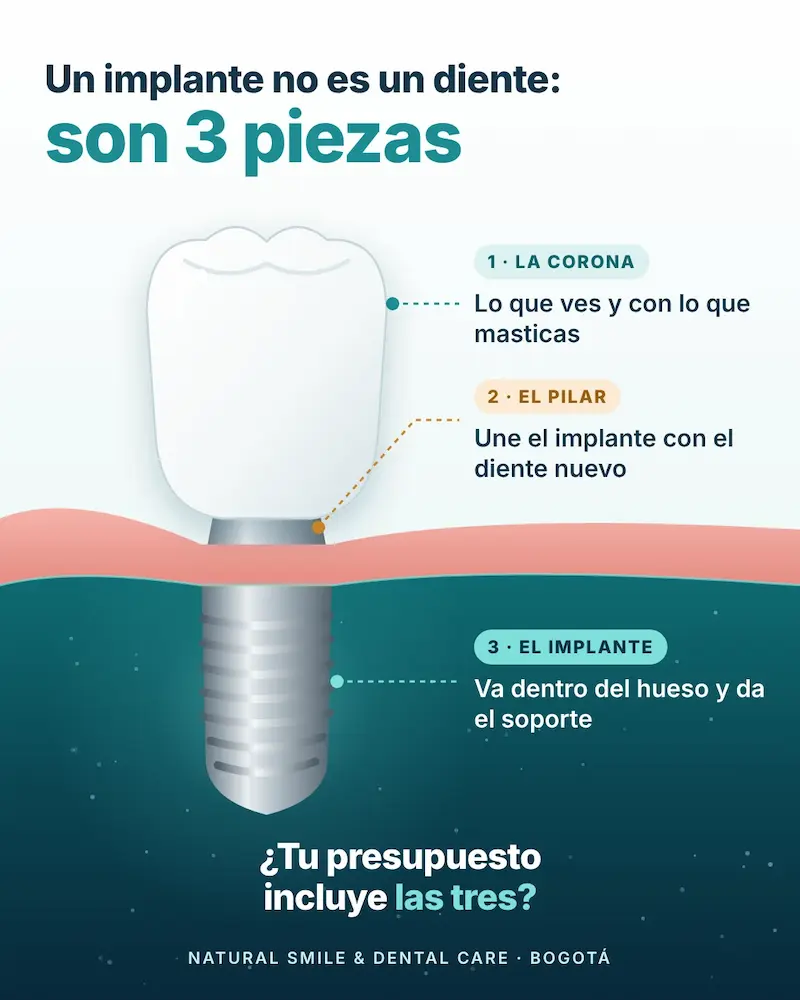
Understanding this changes how you look at a cost estimate: the advertised price for "the implant" doesn't always cover all three parts. According to the U.S. Food and Drug Administration (FDA),implants can restore your ability to chew and improve your appearance, but their benefits and risks must be evaluated on an individual basis.
Before replacing a tooth, ask yourself if it can be saved
When a tooth is severely damaged, the first reaction is often to extract and replace it. But not every compromised tooth needs to come out. Depending on your diagnosis, some teeth can be saved with a root canal, a restoration, or a crown.
The right question isn't always "Which implant do I need?", but rather "Can my natural tooth still be saved?" If the answer is yes, it's worth exploring your oral rehabilitation options in Bogotá before making a final decision.
When is a dental implant a good option?
- When you’ve already lost a tooth due to an accident, severe tooth decay, or another reason.
- When a tooth cannot be saved through other treatments.
- When you want to replace one or more missing teeth with a permanent, fixed solution.
- When your overall health, gums, and bone density allow for it.
Not everyone is an immediate candidate. Some people need to treat their gums first, manage an underlying health condition, or undergo bone grafting before receiving an implant.
Dental Implant or Fixed Bridge?
Neither is right for everyone. A fixed bridge relies on neighboring teeth to support the missing one, while a dental implant replaces the tooth without touching adjacent teeth whenever possible. The right choice depends on the condition of those neighboring teeth, available bone structure, your oral hygiene habits, your budget, and your personal preferences. The Asociación Dental Americana recognizes implants, bridges, and dentures as valid options, provided a thorough professional evaluation is completed first.
What the price of a dental implant actually includes
It's one of the first questions people ask, and understandably so—replacing a tooth is an investment that requires proper planning. However, the price of dental implants in Bogotá isn't determined solely by the screw placed in the bone. It depends on your specific case, any diagnostic tests you need, and the components and procedures required for your treatment.
Before comparing quotes, make sure to check if they include:
- The initial consultation.
- Diagnostic X-rays or 3D scans, if needed.
- The surgery to place the implant.
- The abutment and crown.
- Additional procedures, such as bone grafts or gum treatments, if required.
- Follow-up visits.
Imagine receiving two very different estimates. One seems much cheaper, but doesn't include the crown or follow-up checkups. The other covers all stages from the start. Without reviewing what is included in each, it’s impossible to determine the true cost.
That's why you should always ask for a clear explanation of what’s covered, what might trigger additional costs, and what happens if your treatment plan changes along the way. Price matters, but knowing exactly what you're paying for matters even more.
Does getting a dental implant hurt?
It's one of the most common concerns, especially if you've had bad experiences at the dentist in the past. The implant placement is done under local anesthesia, so during the procedure, it's normal to feel pressure or vibration, but not pain. If you feel any pain, just let the specialist know so they can manage it right away.
Afterward, everyone's recovery is a bit different. Some people experience mild discomfort for the first few days, while others might have more swelling or sensitivity, especially if their treatment involved additional procedures. Your specialist should explain what to expect in your case and what aftercare steps to follow.
However, there are warning signs that call for a prompt checkup: pain that gets worse instead of better, fever, bleeding that won't stop, pus, or the feeling that the implant is loose. These don't necessarily mean something went wrong, but it's always best to have them checked promptly.
How long does a dental implant treatment take?
This comes as a surprise to many people: placing the implant and completing the treatment almost never happens in a single visit. In some cases, a temporary tooth can be placed right away, but not every patient meets the conditions for that.
The process usually involves five stages:

- Evaluation and planning: Your mouth and overall health are examined, and any necessary diagnostic tests are completed.
- Preparación: If there is an active infection, gum disease, or insufficient bone, these are treated beforehand.
- Surgery: The implant is placed in the planned position.
- Healing: The jawbone fuses with the implant to anchor it securely. According to the FDA, this process can take several months or longer.
- Final tooth and follow-ups: Once everything has stabilized, the final crown is placed, and routine checkups begin.
Taking the time for each stage isn't a waste of time—it's what gives the implant a solid foundation to last long-term. At Natural Smile & Dental Care, our maxillofacial surgery team handles implant placement and bone grafts, while our oral rehabilitation team takes care of the teeth that go over them. This ensures your treatment is fully planned out from the very beginning.
Risks you should know about
Implants are a widely used solution for replacing teeth. However, like any surgery, they carry risks. Being aware of them doesn't mean they will happen; it means you can make an informed decision.
The FDA notes several possible complications, including infections around the implant, numbness caused by nerve damage, loose components, and, in some cases, failure of the implant to properly fuse with the bone. Some of these issues can occur shortly after surgery, while others may develop long after.
Smoking, poor oral hygiene, conditions like uncontrolled diabetes, and a history of gum disease can all negatively impact the outcome. Having diabetes doesn't automatically rule you out for an implant, but it does require careful evaluation. For that reason, if gum issues are present, periodontal treatment may be necessary before considering an implant.
The complication almost nobody talks about
An implant can get sick too. Peri-implantitis is an inflammation of the gums and bone surrounding an implant, which can lead to loss of the supporting bone. In its early stages, it doesn't always cause symptoms—sometimes only bleeding or swelling appears. The American Academy of Periodontology explains that daily cleaning and professional checkups are the best way to prevent it.
How long does a dental implant last?
You may have heard that an implant lasts a lifetime. While many function well for decades, no responsible professional should guarantee the exact same lifespan for everyone. It depends on the health of your gums, how the treatment was performed, your personal habits, and your regular checkups.
It is also helpful to keep in mind that the implant and the crown are separate components: over time, the crown may need adjustments or replacement even if the implant itself remains firmly in place. Proper care doesn't end when you receive your new tooth:
- Brush it just like your natural teeth and clean thoroughly around the area.
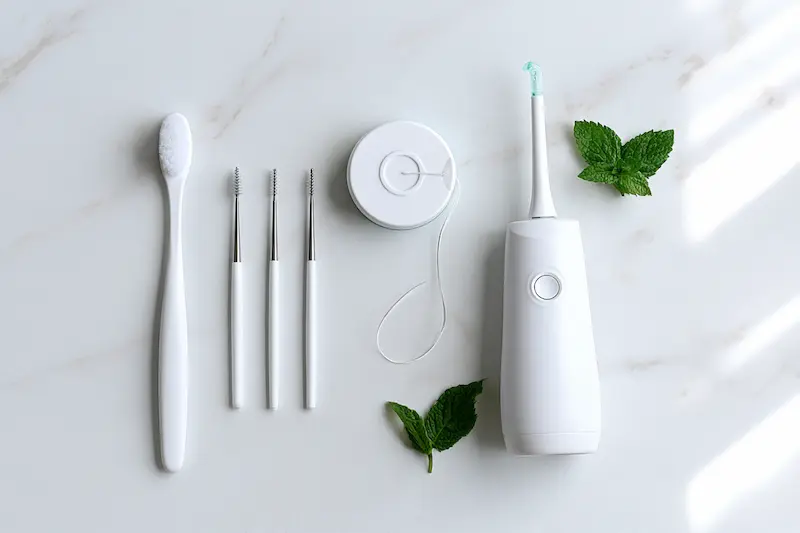
- Use the specific cleaning tools recommended by your specialist.
- Attend your periodic checkups.
- Seek prompt evaluation if you notice bleeding, pain, or any movement.
- Avoid smoking.
Questions worth asking before you start
With so many clinics, promotions, and online reviews, choosing the right provider can be harder than it seems. Before deciding, ask who will perform the surgery and who will design your new tooth, what diagnostic studies you need, if there are other alternatives for your case, what exactly the cost breakdown includes, and what follow-up care looks like. If you want a more comprehensive guide, check out our 7 questions you should ask an oral rehabilitation specialist..
If you live outside Bogotá or outside Colombia, add one more question: how many visits will you need and how follow-up care will be handled once you return home. Since the jawbone requires months to heal, it isn't always possible to complete the entire treatment in a single trip.
What nobody explains to you, we explain in your evaluation
Losing a tooth changes more than just your appearance: it changes how you chew, how you speak, and how confidently you smile. But replacing it shouldn't be a race against the clock or a decision based solely on price.
At Natural Smile & Dental Care, we believe the best decision begins with a conversation. During your evaluation for dental implants in Bogotá, we'll examine whether your natural tooth can still be saved, whether you are a good candidate for an implant, and what other options are available to you. We'll walk you through every step, how long it will take, and what the detailed cost estimate includes for your specific case. Bring all your questions—even the ones you think nobody answers.
We are located at Calle 98 #15-17, Manhattan Center, Suite 709, in the Chicó area, just a few blocks from Parque de la 93.
You don't have to decide everything today. Your smile deserves a well-informed decision, and that decision can start with a conversation.
Reach out to us on WhatsApp or call us at 316 767 3946 to book your consultation.
References
American Academy of Periodontology. (s. f.). Peri-implant diseases. https://www.perio.org/for-patients/periodontal-treatments-and-procedures/dental-implant-procedures/peri-implant-diseases/
American Dental Association. (s. f.). Implants. MouthHealthy. https://www.mouthhealthy.org/all-topics-a-z/implants
U.S. Food and Drug Administration. (s. f.). Dental implants: What you should know. https://www.fda.gov/medical-devices/dental-devices/dental-implants-what-you-should-know
 Español
 English