

Emergency Root Canal in Bogotá: When Can Tooth Pain No Longer Wait? According to the World Health Organization, tooth decay affects billions of people worldwide and, when left untreated, can cause pain, infection, and tooth loss. But when a tooth starts throbbing, hurts when you bite, or keeps you up at night, what you probably need is to know what's going on and how to relieve that pain as soon as possible.
You want to know something more specific: can I wait, or do I need care right away?
If you're searching for Emergency Root Canal in Bogotá because of severe pain, swelling, or discomfort that has quickly gotten worse, the first thing to understand is that not every toothache requires root canal treatment. The diagnosis must confirm which structure is affected and the best way to treat it.
At Natural Smile & Dental Care, root canal treatment aims to control pain and infection, restore function, and preserve the natural tooth whenever its condition allows. Before starting, the dentist should evaluate the source of the problem and explain your options.
When Do You Need an Emergency Root Canal?
Root canal treatment, also known as endodontic treatment, may be necessary when the dental pulp (the inner tissue of the tooth where the nerves and blood vessels are found) is inflamed or infected.
A deep cavity can reach that area. It can also be affected by a fracture, a blow to the tooth, a faulty restoration, or previous dental work.
The American Association of Endodontists (AAE) notes that some signs associated with pulp problems include severe pain when chewing or biting, lingering sensitivity to cold or heat, swollen gums, deep cavities, fractures, and dental trauma.
Not all of these symptoms confirm that you need a root canal, but they do warrant a priority dental evaluation.
Warning Signs You Shouldn't Ignore
Seek care if you have severe or persistent pain in a tooth, especially if it gets worse when you chew. You should also see a dentist if sensitivity to cold or heat lasts for several seconds or minutes after the trigger is removed.
A throbbing sensation inside the tooth, swollen gums, a small bump, pus, or a bad taste in your mouth may be related to an infection. It's also important to have any tooth checked that is broken, cracked, injured, or has noticeably changed color.
Pain that wakes you up at night is another warning sign. If it eases for a few hours, that doesn't necessarily mean the problem is gone. Some pulp conditions change in intensity over time and can create a false sense of improvement.
Unbearable Toothache: What's Happening Inside the Tooth?
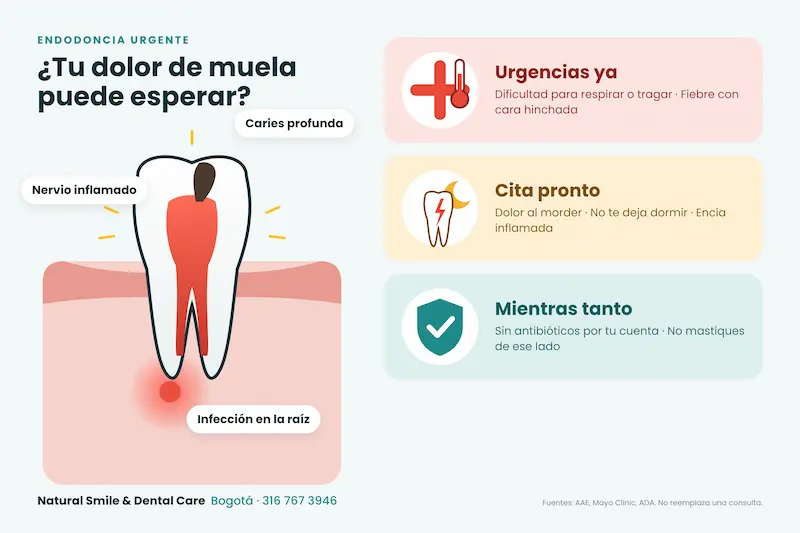
The dental pulp is located inside the tooth and contains nerve tissue and blood vessels. When decay, a fracture, or trauma reaches that area, intense inflammation can occur.
At first, the pain may only appear when you have something cold or hot. Later, it may last longer, appear without any trigger, or get worse when you lie down. Some people feel it as a throbbing pressure; others have trouble identifying which tooth is causing the problem because the pain radiates to the jaw, ear, or head.
When the pulp is irreversibly inflamed or infected, root canal treatment aims to remove the affected tissue, clean and disinfect the root canals, and seal them to prevent them from becoming contaminated again.
A treated tooth usually needs a final restoration afterward. If it has lost a lot of structure due to decay or fractures, a crown can help protect it and restore its function. That's why a root canal isn't always the last step of treatment.
When Is a Dental Infection an Emergency?
A dental infection needs timely dental care, but some signs may indicate that it's spreading and requires immediate medical attention.
Mayo Clinic, one of the leading medical centers in the United States, recommends going to an emergency room if you have trouble breathing or swallowing. It also considers fever along with significant facial swelling an emergency, especially if you can't reach a dentist quickly.
Don't wait for a regular appointment if you have significant swelling in your face or neck, difficulty opening your mouth, trouble breathing or swallowing, fever with a general decline in how you feel, or swelling that is increasing rapidly.
A dental abscess can cause throbbing pain, sensitivity to cold or heat, pain when chewing, swelling, pus, or a bad taste. Even if the abscess drains and the pain decreases, the infection may still be present. Temporary relief is no substitute for treating the cause.
What Happens When You Arrive in Pain?
Going to the dentist in pain can be frightening. You may wonder whether they'll do a root canal, whether they'll have to pull the tooth, or whether they'll just send you home with medication.
The first thing should be a diagnosis.
The dentist needs to know how the pain started, what triggers it, how long it lasts, and whether it has gotten worse. Next, they'll examine the tooth, the gums, and the surrounding tissues. They may also perform sensitivity tests and take an X-ray to check the root and the bone around the tooth.
The evaluation makes it possible to determine whether the pulp can still recover, whether the inflammation is past the point of no return, whether the tooth's nerve has already died, whether there is infection around the root, or whether the tooth needs a different treatment.
This process is important because not all pain comes from the nerve. It may be caused by a crack, a high filling, a cavity, gum inflammation, or even a neighboring tooth.
How Is a Root Canal Done?
Root canal treatment is usually performed under local anesthesia. The dentist then accesses the inside of the tooth to remove the affected pulp tissue.
The root canals are cleaned and disinfected. They are then filled and sealed to reduce the risk of new contamination. Finally, the tooth is restored according to how much structure it has left.
Not all root canals are equally complex. A front tooth normally has a simpler anatomy than a molar (back tooth), which may have several canals. It can also be more complex to treat a tooth that already had a root canal and needs to be treated again.
For that reason, it isn't responsible to promise the same treatment time, number of appointments, or price to every patient. The diagnosis determines the true complexity.
Does a Root Canal Hurt?
This question often hides another concern: “It already hurts so much. Are you going to make me suffer even more?”
It's understandable to be afraid. Root canal treatment is usually performed under local anesthesia, and the goal is to treat the cause of the pain. During the procedure, you may feel pressure, vibration, or the need to keep your mouth open, but the dentist should know if you feel pain and adjust their approach when necessary.
Afterward, you may have some sensitivity or discomfort for a few days, especially when biting. The AAE acknowledges that this discomfort can occur during recovery.
How you're treated also makes a difference. A patient who feels free to say “I'm scared,” ask for an explanation, or speak up when something is bothering them experiences the visit in a different way. Natural Smile & Dental Care offers personalized support for patients who come in feeling anxious or afraid of the dentist.
Information restores an important feeling: control. Knowing what they're going to do, why they're doing it, and what to expect reduces uncertainty.
Can Antibiotics Prevent a Root Canal?
Not necessarily.
Antibiotics can be useful in certain situations, especially when there are signs that the infection is affecting your overall health, such as fever or feeling unwell. However, they don't remove infected pulp tissue on their own, nor do they fix a deep cavity, a fracture, or a contaminated canal.
The American Dental Association (ADA) recommends against routinely using antibiotics in most cases of pain or infection that originate in the tooth. In these cases, the priority is the dental treatment recommended by the specialist after evaluating the tooth.
This means an antibiotic shouldn't be used to postpone a dental visit indefinitely. It's also not a good idea to take leftover medication from a previous infection or use someone else's prescription.
If you have pain, swelling, or a suspected infection, the decision should be based on a diagnosis.
What to Do While You Wait for Care
Until you can get an appointment, avoid chewing hard foods with the affected tooth and keep up careful oral hygiene. You can also avoid temperatures that clearly trigger the pain.
Don't place aspirin, alcohol, irritating substances, or medications directly on your gums. This can cause injuries and doesn't solve the cause of the problem.
If you take pain relievers, they should be appropriate for your medical situation, and you should follow the directions of a healthcare professional or the package insert. A temporary reduction in pain doesn't mean the infection has gone away.
If the pain persists, gets worse, wakes you up at night, or comes with swelling, seek dental care. If you also have trouble breathing or swallowing, or a fever with significant facial swelling, go to the emergency room.
Root Canal or Extraction?

Not every tooth can be saved. A fracture that extends deep into the tooth, severe loss of structure, insufficient gum and bone support, or a very poor prognosis can make extraction the safest option.
But a tooth also shouldn't be pulled just because it hurts, without checking whether it can be treated and restored.
The decision should take into account how much tooth structure remains, the condition of the root, the infection, the gums, the bone, and whether the tooth can be restored after the root canal.
When the tooth can be saved, root canal treatment allows you to keep it. Preserving a natural tooth can help maintain function and keep the gap from shifting the position of the neighboring teeth.
The goal isn't to do a root canal at any cost. It's to choose the treatment that offers the best prognosis for that tooth and for your oral health.
How Long It Takes and How Much It Costs
The length of treatment depends on the affected tooth, the number and anatomy of the canals, whether there is an infection, the complexity of the case, and whether it's the tooth's first root canal or a previous one needs to be redone.
Some cases can be resolved in one appointment; others require additional visits, medication between sessions, or a more complex final restoration.
The cost of a root canal in Bogotá also varies. It is influenced by the tooth being treated, the number of canals, anatomical complexity, diagnostic tests, whether a previous root canal needs to be redone, and the restoration required afterward.
That's why an advertised price without evaluating the case doesn't always reflect the total cost. What matters most is knowing what the treatment includes and what the tooth's prognosis is.
Frequently Asked Questions About Emergency Root Canals
How do I know if I need an emergency root canal?
Severe pain when biting, lingering sensitivity, swelling, a deep cavity, a fracture, or trauma may indicate a pulp problem. However, the diagnosis must be confirmed through a clinical evaluation.
Does every severe toothache need a root canal?
No. The pain may be caused by cavities, fractures, gum problems, faulty restorations, bite problems, or other causes. The source must be identified first.
How long can I wait?
There is no safe waiting time that applies to everyone. If you have persistent pain, swelling, fever, or difficulty eating, seek care soon. If the pain comes with trouble breathing or swallowing, go to the emergency room.
Does a root canal eliminate pain immediately?
When it's indicated to treat the cause of the pain, it can help control it. Afterward, there may be temporary sensitivity while the tissues heal.
Can I avoid a root canal by taking antibiotics?
Not necessarily. Antibiotics don't replace the dental treatment the tooth needs and shouldn't be taken without a prescription.
How many appointments does it take?
It depends on the tooth's anatomy, the infection, the number of canals, and whether there was previous treatment. Some cases require one appointment and others several.
Is it better to save the tooth or pull it?
It depends on the prognosis. If it can be restored predictably, saving it may be an option. If it's too damaged, extraction may be indicated.
How much does an emergency root canal cost in Bogotá?
The price depends on the tooth, the complexity, the diagnosis, and the restoration needed afterward. An evaluation makes it possible to provide a more accurate estimate.
Don't Let the Pain Decide for You

When a tooth has been throbbing for hours, it's natural to want it fixed right away. You may just want it pulled or to take something that silences the pain. But making an informed decision can make the difference between losing a tooth that could still have been saved and treating it in time.
At Natural Smile & Dental Care, you can request an evaluation to identify the source of your pain, find out whether you need a root canal, and learn the prognosis of the tooth. The goal is to explain what's happening and what options are available, without absolute promises or rushed decisions.
If you have severe pain, swelling, or sensitivity that won't go away, check availability for an emergency root canal in Bogotá.
Call or message us at +57 316 767 3946. Requesting an evaluation doesn't commit you to any procedure: it helps you understand what's going on and decide with clarity.
References
American Association of Endodontists. (s. f.). Root canal pain: What to expect. https://www.aae.org/patients/root-canal-treatment/root-canal-pain/
American Association of Endodontists. (s. f.). What is a root canal? https://www.aae.org/patients/root-canal-treatment/what-is-a-root-canal/
Lockhart, P. B., Tampi, M. P., Abt, E., et al. (2019). Evidence-based clinical practice guideline on antibiotic use for the urgent management of pulpal- and periapical-related dental pain and intraoral swelling: A report from the American Dental Association. The Journal of the American Dental Association, 150(11), 906–921.e12. https://doi.org/10.1016/j.adaj.2019.08.020
Mayo Clinic. (s. f.). Tooth abscess: Symptoms and causes. https://www.mayoclinic.org/diseases-conditions/tooth-abscess/symptoms-causes/syc-20350901
Organización Mundial de la Salud. (s. f.). Salud bucodental [Nota descriptiva]. https://www.who.int/es/news-room/fact-sheets/detail/oral-health
 Español
 English